How I Build A Healthy Plate

Overall, my clients are very healthy eaters.
At this point, most of them simply expect me to show up on my designated days and fill their refrigerators. They leave the menu planning almost completely up to me, with an occasional request for a favorite dish they’d like to see again.
That means I spend a lot of time thinking about what makes a meal not only delicious, but nourishing, balanced and realistic for the people who are actually going to eat it.
After more than 15 years of cooking for clients, completing my health and life coach training, studying sustainable nutrition through Harvard Medical School Executive Education, doing a great deal of reading about longevity and the Blue Zones, and—perhaps most importantly—listening to what people actually enjoy eating, I’ve developed a pretty simple framework.
I build meals around plenty of plants, a good source of protein and a smaller portion of high-quality carbohydrates, with healthy fats added for flavor, satisfaction and nutrition.
For myself and my omnivore clients, protein might come from fish, poultry, eggs, yogurt, beans, lentils or occasionally beef or pork. For my vegetarian clients, I lean on foods like beans, lentils, tofu, tempeh, edamame, eggs and dairy when appropriate.
Then I load up the vegetables.
I tend to use non-starchy vegetables most often because they allow me to add a tremendous amount of color, texture, fiber and volume to a plate. But that doesn't mean foods like sweet potatoes, winter squash, corn or other starchy vegetables are somehow “bad.” They’re simply another source of carbohydrate, and they can absolutely have a place in a healthy diet.
A Simple Visual: How To Build A Healthy Plate
One of my favorite visuals is built around Harvard’s Healthy Eating Plate.
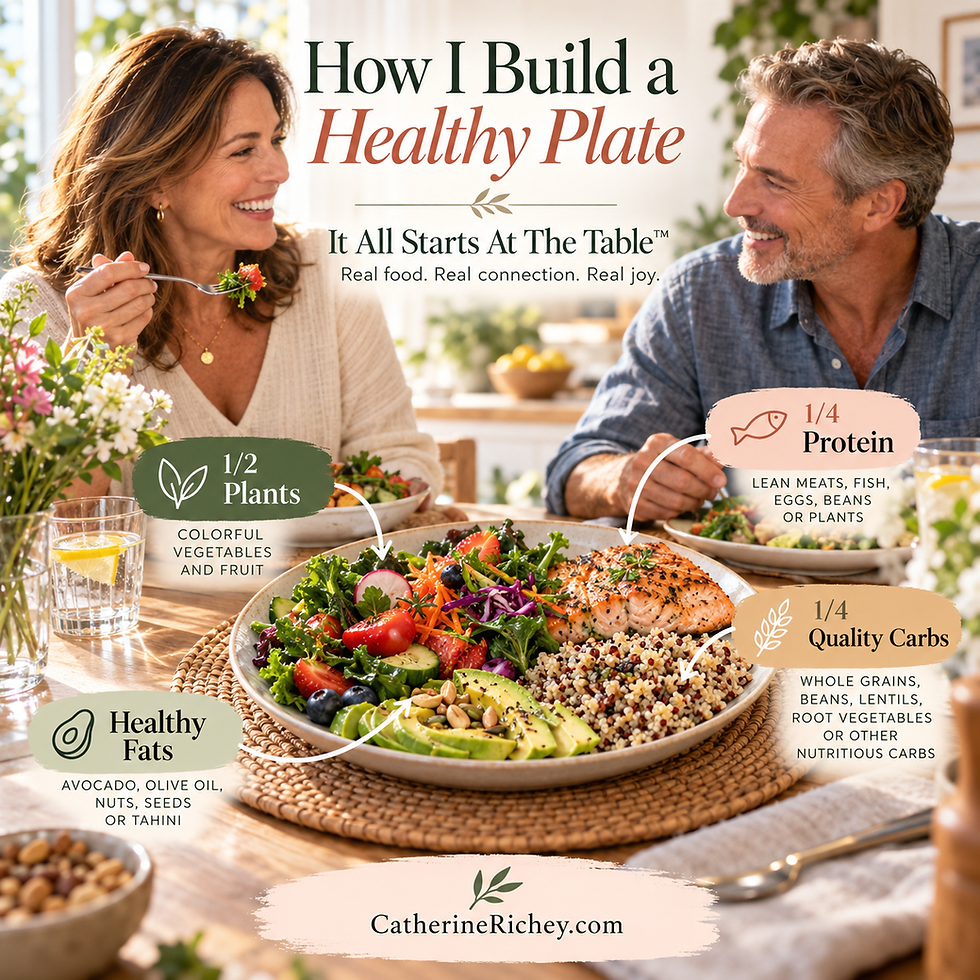
The basic idea is wonderfully uncomplicated:
About ½ the plate: vegetables and fruit, with an emphasis on vegetables and lots of variety
About ¼ of the plate: healthy protein
About ¼ of the plate: whole grains or another high-quality carbohydrate source
Add healthy fats, such as olive oil, avocado, nuts and seeds, in reasonable amounts
It isn't meant to be a rigid prescription or a calorie-counting system. It’s simply a very useful visual starting point.
And that's how I like people to think about food.
Not perfectly. Not obsessively. Just generally heading in a good direction most of the time.
But How Much Protein Do You Need?
This is where nutrition gets more individual.
Protein needs change depending on body size, age, activity level, health status and whether you're trying to maintain or build muscle.
For a generally healthy adult, the longstanding Recommended Dietary Allowance, or RDA, for protein is 0.8 grams per kilogram of body weight per day.
Here's the simple math:
Body weight in pounds ÷ 2.2 = body weight in kilograms
Then:
Body weight in kilograms × 0.8 = grams of protein per day
For example, a 160-pound person:
160 ÷ 2.2 = about 73 kg
73 × 0.8 = about 58 grams of protein per day
Think of that number as a basic reference point rather than a perfect prescription.
Research suggests that older adults, very active people and people working to preserve or build muscle may benefit from more protein than the basic RDA.
You may also have heard that your body can only “process” a certain number of grams of protein at one time. That isn't quite accurate. Your body can digest and use protein beyond 20 or 30 grams at a meal. What researchers have studied is how much protein at one sitting appears to maximize muscle protein synthesis—the process of repairing and building muscle. Depending on factors including age, body size and activity, roughly 20–40 grams of high-quality protein at a meal, or around 0.4 grams per kilogram of body weight, is often used as a practical target.
I find it much more useful to think about spreading protein throughout the day than trying to consume most of it at dinner. And more is not automatically better. If you have kidney disease, another medical condition that affects your dietary needs, or you've been given specific nutrition instructions by your healthcare provider, this is absolutely an area to discuss with your physician and/or a registered dietitian.
Eat the Rainbow. Yes, Really.
There is also very good reason for all those colorful vegetables I keep piling onto people's plates.
Different fruits and vegetables provide different vitamins, minerals, fibers and thousands of naturally occurring plant compounds called phytonutrients.
The colors are clues.
Dark leafy greens offer a different mix of nutrients and plant compounds than tomatoes. Blueberries and blackberries contain different compounds than carrots and winter squash. Garlic, onions and mushrooms bring still another group to the table.
That doesn't mean you need to stand in your kitchen with a checklist making sure you consumed something red, orange, yellow, green and purple before bedtime.
Please don't make eating that complicated. Instead, zoom out and look at your week.
Did you eat greens? Berries? Tomatoes? Herbs? Squash? Beans? Citrus? Cruciferous vegetables? Mushrooms? Apples?
Variety matters.
You'll sometimes hear recommendations expressed as a certain number of “servings” of fruits and vegetables per day. Rather than obsessing over an exact number, I like the much more practical goal of making plants a substantial part of your meals and changing them up regularly. Somewhere around five or more servings a day is a very reasonable place to begin for many people.
And one small clarification about antioxidants: our bodies actually do have their own antioxidant defense systems. But plants provide vitamins, minerals and phytonutrients that work through many different biological pathways—including antioxidant activity. The benefits of fruits and vegetables seem to come from the whole package, not from chasing one magical antioxidant or taking it in supplement form.
In other words:
Eat the blueberries. You don't need a $49 bottle of “blueberry antioxidant complex.”
You Don't Need to Measure Everything
Unless you have a medical reason to closely track nutrients, or you're intentionally trying to gain or lose weight and need more precision, you probably don't need a food scale sitting beside your dinner plate.
Start here:
½ plants.¼ protein.¼ whole grains or another quality carbohydrate.A little healthy fat.
Then adjust for your body, your hunger, your activity level and your life.
A teenager swimming twice a day is going to need a very different plate than a sedentary 70-year-old. Someone trying to build muscle may need more protein. Someone training for an endurance event may need considerably more carbohydrate.
There is no single perfect plate for every human being.
There are simply good principles that we can personalize.
And Yes, There Is Still Room for Dessert
The recipes you'll find here on my website—and increasingly on my YouTube channel—reflect the way I cook for my clients and for myself.
Lots of vegetables. Good protein. Whole and minimally processed foods. Herbs, spices, texture and big flavor.
And every once in a while, I'm going to make you dessert. Because food is nutrition, but it is also pleasure, tradition, hospitality and connection. Healthy eating should leave room for all of those things.
A Very Recent Real-Life Test
Two weeks ago, I unexpectedly ended up in the hospital and had emergency gallbladder surgery.
After surgery, my surgeon advised me to keep saturated fat low while my digestive system adjusted.
And for once, I thought: Well, this part is easy. That's already predominantly how I eat.
I didn't have to suddenly reinvent my refrigerator or figure out how to prepare foods I wasn't accustomed to eating. I came home to oatmeal, yogurt and berries, lean proteins, vegetables, whole grains and simple meals that already felt completely normal to me.
I'm very grateful that my recovery has gone exceptionally well so far, and I've had very few noticeable digestive issues since losing my gallbladder. Can I say that's because I was already eating this way? No. Healing is much more complicated than that. But I can say that having an established way of eating built around simple, nourishing foods made one part of recovering from an unexpected surgery much easier. And that, really, is the point.
Healthy eating shouldn't be something you suddenly have to figure out when life goes sideways. It can simply become the way you generally eat. Nothing extreme. Nothing perfect. Just good food, most of the time.
It All Starts At The Table™.
If you'd like to be notified whenever I add new recipes and articles to the website, subscribe to the blog.
You can also follow me on social media and YouTube for cooking videos, recipes and practical tips I've picked up from more than 15 years of cooking professionally.


Catherine!
This is all so wonderful. THANK YOU!!
It’s Becky, so blessed by all of what you are sharing and I am so appreciative of getting to glean from this beautiful resource!!